November 18, 2026
Continuing our annual tradition, to mark World AMR Awareness Week (November 18–24, 2026), we have curated a collection of One Health Trust articles, policy briefs, podcasts, and infographics published over that last year that explore the many complexities of and potential solutions for this global challenge.
Research Articles
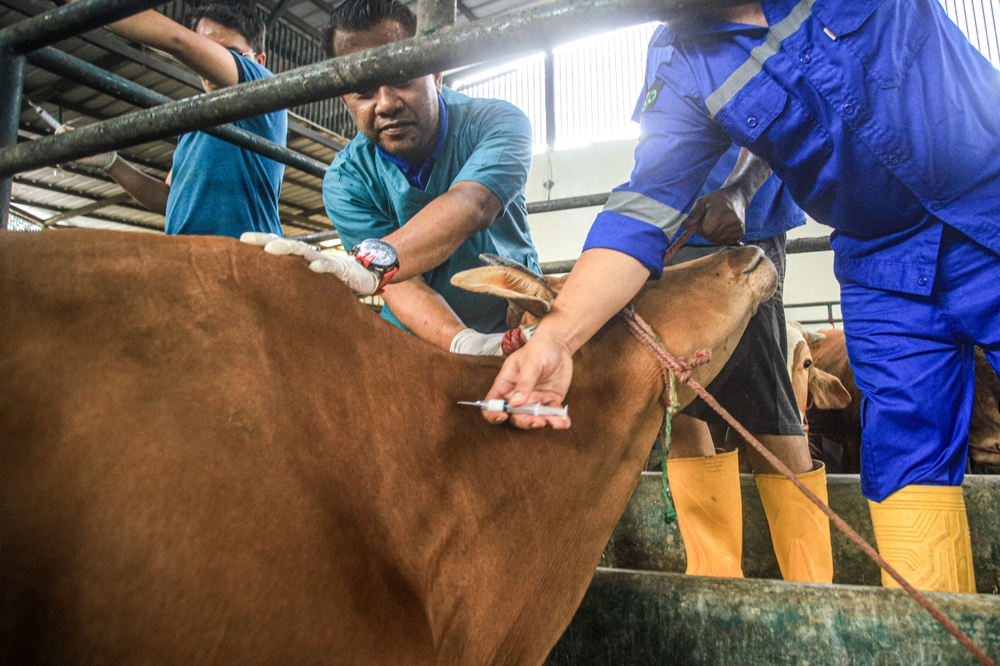
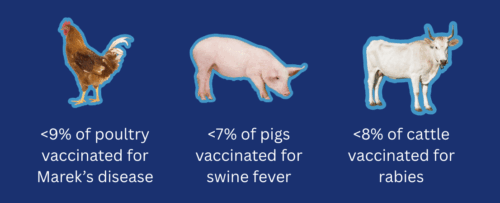
Low vaccination coverage in food animals for high-burden diseases worldwide
Vaccination coverage against high-burden diseases in food animals remains low worldwide, but especially in low- and middle-income countries (LMICs). An OHT-led analysis of data from the World Organisation for Animal Health on 104 livestock diseases affecting cattle, pigs, and poultry across 203 countries from 2005–2025 reveals large gaps and regional variation in vaccination coverage for high-impact diseases such as foot-and-mouth disease, brucellosis, rabies, Newcastle disease, and classical swine fever. Expanding livestock vaccination coverage would greatly benefit LMICs, by reducing global disease burden, reducing antibiotic use, improving productivity and economic outcomes, and lowering greenhouse gas emissions. There is a need for urgent action to assess and improve animal vaccine efficacy, identify priority antigens, and scale up vaccine production to reduce costs. [PNAS]
Climate change and antimicrobial resistance
A review by OHT’s Dr. Erta Kalanxhi and Dr. Ramanan Laxminarayan examines the association between climate change and AMR. Rising temperatures and extreme weather events fuel more frequent disease outbreaks, healthcare disruptions, migration, and food insecurity, raising the risk of infections and reliance on antimicrobials. Ecological studies show significant correlations between higher AMR prevalence in key pathogens and warmer temperatures, however, the evidence remains largely associative. The paper calls for more rigorous research to shed light on temporality, causality, and pathways through which changing climates impact health and AMR. Additionally, it suggests actions to mitigate the impact by reducing the incidence of infections through measures such as access to clean water, healthcare, and sustainable agriculture. [Nature Microbiology]
Gender inequality is linked to differences in antibiotic consumption across countries.
Gender roles and access to resources influence health habits in different communities worldwide, particularly those related to antibiotic use. OHT’s Dr. Deepshikha Batheja and Dr. Arindam Nandi analyzed antibiotic consumption data and gender quality indicators from 70 nations between 2000 and 2022. A higher proportion of women was linked to slightly higher antibiotic use; however, nations with greater female education and more female labor force participation consistently reported lower consumption. These trends persisted across time periods and income levels, demonstrating how the social and economic aspects of gender disparity affect antibiotic use and underscoring the need for gender-responsive strategies to combat antimicrobial resistance. [Journal of Antimicrobial Chemotherapy]
Studying antimicrobial resistance through gender and climate lenses
An article co-authored by OHT’s Dr. Deepshikha Batheja presents findings from workshops in India and South Africa on how gender inequality, climate change, and antimicrobial resistance (AMR) interact to shape health risks in low- and middle-income communities. Researchers, policymakers, clinicians, and community representatives noted that climate shocks and unequal access to healthcare increase AMR risks, particularly for women and vulnerable groups. They stressed the need for cross-sector cooperation, community involvement, and improved health communication to build fair, gender-responsive AMR strategies. [JPHIA]
Rethinking the fight against antibiotic resistance
Meeting the United Nations’ target of a 10 percent reduction in antibiotic resistance-related deaths by 2030 will require more than just developing new drugs. In the Garrod Lecture, OHT’s Dr. Ramanan Laxminarayan stresses the importance of fixing the antibiotic market, expanding access to existing and new antibiotics, and strengthening diagnostics. Current markets for antibiotics lack commercial viability in low-income countries and sales are heavily concentrated due to unaffordable prices and lack of diagnostics. Expanding access to existing antibiotics could avert many deaths, as a recent analysis revealed that only a small fraction of carbapenem-resistant infections in 8 LMICs received optimal treatment. Additionally, while diagnostics are critical to appropriate use, they remain scarce in LMICs. Laxminarayan stresses that too much focus on new drugs has left gaps in access to diagnostics and antibiotics unaddressed. [Journal of Antimicrobial Chemotherapy]
Can the world meet the UN’s 2030 targets on AMR?
At the 2024 United Nations General Assembly, countries committed to reducing deaths associated with bacterial AMR by 10 percent and increasing the use of Access antibiotics to 70 percent by 2030. According to experts, including OHT’s Dr. Ramanan Laxminarayan, these objectives will rely less on the development of new antibiotics and more on prevention-focused tactics, including increased immunization, more effective infection control, better access to existing antibiotics, and improved water and sanitation. However, the authors caution that the significant gaps in diagnostic and surveillance capabilities, especially in low- and middle-income nations, make it challenging to confirm progress. Additionally, they warn that local resistance trends and treatment realities may not be fully reflected in worldwide antibiotic use targets. [The Lancet]
Delaying action on livestock antibiotic use could prove extremely costly.
An economic analysis warns that failing to curb antibiotic use in livestock may carry far higher long-term costs than the short-term setbacks of reform. Researchers, including OHT’s Dr. Ramanan Laxminarayan, project that unchecked AMR could result in losses of US$318 billion in livestock production and US$1.25 trillion in broader economic welfare losses by 2040. In contrast, eliminating growth promoters could temporarily reduce livestock production by about US$53 billion between 2025 and 2040. Systems most susceptible to production shocks were those involving pork and poultry. The results imply that the long-term economic risks of doing nothing about AMR may exceed the short-term adjustment costs. [Journal of Agricultural Economics]
New livestock policies can help curb AMR.
Governments can implement livestock policies to reduce antibiotic use on farms without compromising animal health and productivity. In a new Food and Agriculture Organization (FAO) report, experts, including OHT’s Dr. Ramanan Laxminarayan, map how countries can move away from routine antibiotic use in food-animal production through incentives, regulations, better veterinary care, and improved farm management. Because AMR threatens both animal and human health, the report emphasizes that progress demands coordinated action among sectors. It highlights strategies that promote vaccination, biosecurity, disease prevention, and antibiotic stewardship that enhance food systems while reducing the need for antibiotics. Smarter livestock policy is critical to long-term global efforts to control the spread of AMR. [Food and Agriculture Organisation of the United Nations]
Wastewater surveillance can strengthen the fight against antimicrobial resistance.
OHT’s Dr. Ramanan Laxminarayan and colleagues highlight wastewater surveillance as a vital tool for monitoring antibiotic resistance, but only if designed around specific public health goals. Instead of gathering data for its own purpose, they suggest an objective-driven approach that ties monitoring to goals such as enhancing wastewater treatment and lowering exposure to resistant microorganisms, ultimately influencing antibiotic policies. This strategy can assist nations in developing more effective One Health programs to fight antibiotic resistance, emphasizing that different public health goals demand different surveillance techniques. [Nature Microbiology]
Antibiotics: use more wisely, not simply less
A study co-authored by OHT’s Dr. Ramanan Laxminarayan analyzes antimicrobial resistance (AMR) and socioeconomic data from 186 countries and territories to estimate optimal antibiotic use based on the World Health Organization (WHO) AWaRe classification– a system that groups antibiotics into Access, Watch, and Reserve categories to guide their appropriate use. Estimates suggest that around 43 billion defined daily doses of antibiotics were required worldwide in 2019, of which 77 percent should preferably belong to the Access group. However, the study shows that nearly all (99 percent) 67 nations with actual-use data had greater than the recommended reliance on Watch antibiotics, with 72 percent using more than the predicted optimal amounts. At the same time, the study highlights significant availability gaps, especially for Reserve antibiotics in lower-income settings, demonstrating the need for AMR control strategies to address both inadequate antibiotic access and overuse. [The Lancet Public Health]
AMR cannot be tackled without confronting inequity.
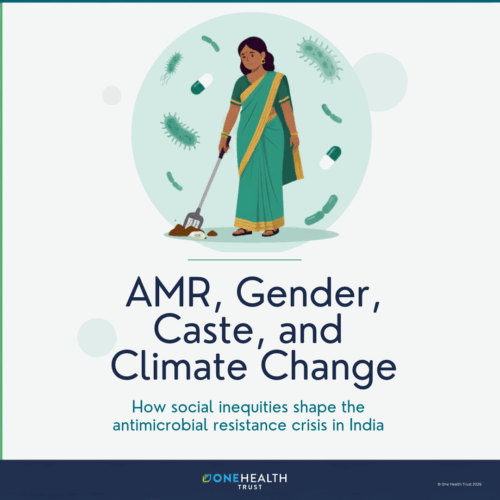
One Health Trust researchers and collaborators examined how socioeconomic, environmental, and healthcare disparities impact the emergence and spread of antimicrobial resistance (AMR). Drawing on discussions from a two-day interdisciplinary workshop in Bengaluru, India, the authors explored how gender, caste, and climate change interact with infection risk, health-seeking behaviors, and access to antibiotics and high-quality treatment. In addition to advocating for AMR surveillance, evidence generation, and policies that better account for inequities, the authors offer a conceptual framework for understanding how caste-based discrimination influences antibiotic use and AMR in India and other South Asian countries. [Cambridge University Press]
Structural uncertainties are driving prolonged antibiotic prescribing in low- and middle-income countries.
Shorter antibiotic courses are increasingly recognized as safe and effective yet remain uncommon in many low- and middle-income countries (LMICs). In a commentary, researchers, including OHT’s Dr. Deepshikha Batheja, argue that prolonged prescribing may be better understood as a rational response to clinical uncertainty rather than as a simple stewardship failure. Diagnostic limitations, delayed test results, and constrained healthcare resources paired with poor healthcare access may push clinicians to prescribe longer courses. These prescribing habits represent attempts to manage medical uncertainty and ensure patient safety when post-treatment follow-up care remains highly unreliable. Therefore, reducing unnecessary use requires strengthening health systems to lower uncertainty and not just change in prescriber behavior. [The American Journal of Bioethics]
Policy Briefs
Since its launch in 2008, the One Health Trust-led Global Antibiotic Resistance Partnership (GARP) has played a pivotal role in advancing country-led strategies and policies to address AMR across Africa and Asia. Today, GARP is focused on generating cross-disciplinary evidence to demonstrate how vaccines can help tackle AMR, with a particular emphasis on country-specific contexts and priorities.
From 2025 to the present, all 10 current GARP country teams have published policy briefs presenting evidence-based insights and actionable, context-specific recommendations on how to leverage vaccines as part of national efforts to combat AMR. Explore these policy briefs to hear from One Health Trust researchers and local experts, leaders, and stakeholders working at the intersection of AMR and immunization. Discover perspectives and recommendations from GARP teams in Uganda, Nepal, South Africa, Pakistan, Kenya, India, Bangladesh, Côte d’Ivoire, Viet Nam, and Mozambique.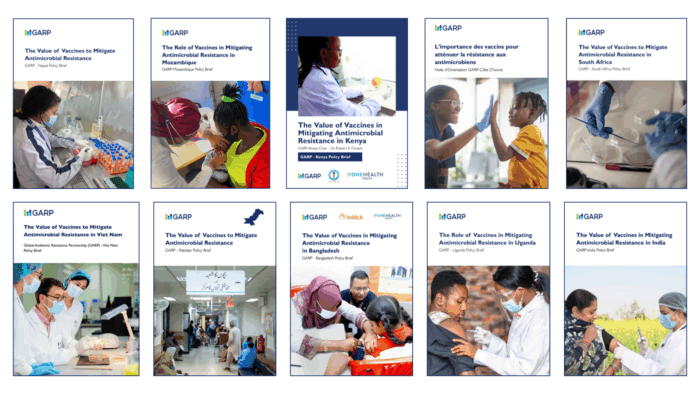
The hidden crisis of antibiotic access in Latin America
While antimicrobial resistance (AMR) is a major source of global mortality, even more people die simply because they cannot get access to the antibiotics they need. In partnership with the South Centre, the One Health Trust launched the policy brief, “Prioritize Antibiotic Access to Tackle Resistance,” in English, Spanish, and Portuguese at the First International Conference on Antimicrobial Resistance in the Americas and Caribbean Region, held in Brasília, Brazil, from March 24–27, 2026. The brief presents evidence on the global consequences of inadequate access to antibiotics, examining key structural, economic, and health system barriers across the region, and shares real-life examples from Latin America illustrating the public health impact of limited antibiotic access. The brief concludes with clear recommendations to ensure people have quick, appropriate, and equitable access to effective antibiotics. [One Health Trust]
One World, One Health Podcasts
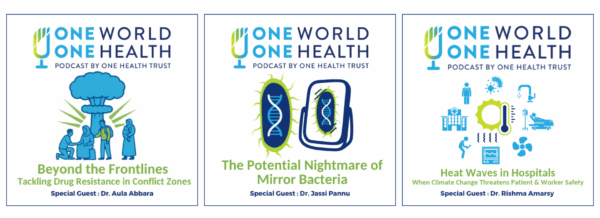
Dr. Aula Abbara in Beyond the Frontlines – Tackling Drug Resistance in Conflict Zones
Dr. Jassi Pannu in The Potential Nightmare of Mirror Bacteria
Dr. Rishma Amarsy in Heat Waves in Hospitals – When Climate Change Threatens Patient & Worker Safety
Infographics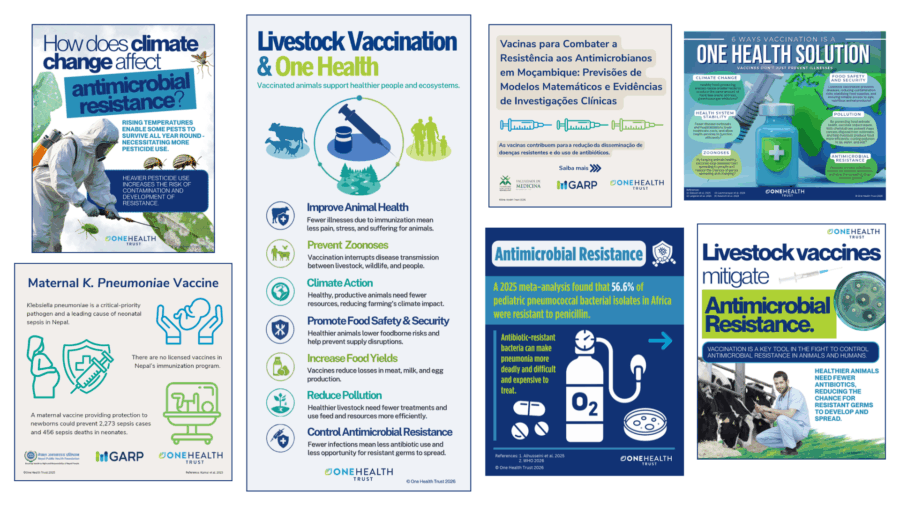
Vaccination Coverage in Food Animals for High-Risk Diseases
6 Ways Vaccination is a One Health Solution
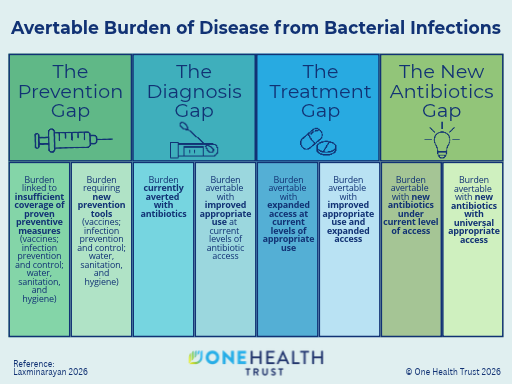
Avertable Burden of Disease from Bacterial Infections
The Impact of Climate Change on Antimicrobial Resistance is a One Health Issue
Animal health is central to human & ecosystem health – Livestock Vaccination & One Health
AMR, Gender, Caste, and Climate Change
Livestock Vaccination & One Health
Global Antibiotic Resistance Partnership (GARP) Infographics
Pakistan
The impact of Antimicrobial Resistance in Pakistan
Vaccines to Control Antimicrobial Resistance in Pakistan
Kenya
The Impact of Antimicrobial Resistance in Kenya
Vaccines to Control Antimicrobial Resistance in Kenya
India
The Impact of Antimicrobial Resistance in India
Vaccines to Control Antimicrobial Resistance in India
Bangladesh
The Impact of Antimicrobial Resistance in Bangladesh
Vaccines to Control Antimicrobial Resistance in Bangladesh
Mozambique
English- Vaccines to Control Antimicrobial Resistance in Mozambique
The Impact of Antimicrobial Resistance in Mozambique
Portuguese- Vacinas para Combater a Resistência aos Antimicrobianos em Moçambique
O Efeito da Resistência aos Antimicrobianos em Moçambique
Côte d’Ivoire
English- The Impact of Antimicrobial Resistance in Côte d’Ivoire
Vaccines to Control Antimicrobial Resistance in Côte d’Ivoire
French- L’impact de la résistance aux antimicrobiens en Côte d’Ivoire
Vaccins pour lutter contre la résistance aux antimicrobiens en Côte d’Ivoire