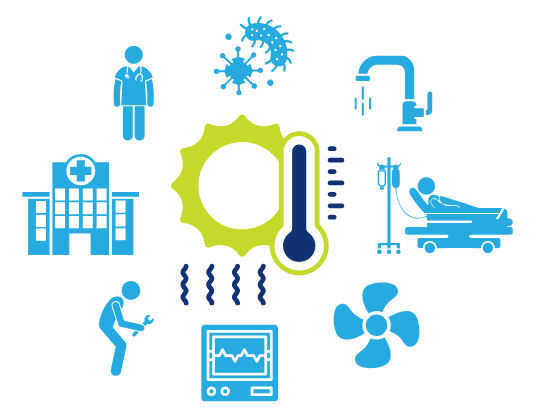
The 2026 summer in Paris was the hottest on record – so hot that it killed thousands of people. Across Europe, 50,000 people died in cities because of the heat, according to researchers at Imperial College London and the London School of Hygiene & Tropical Medicine.
For 52 days straight temperatures were intense, sending people to emergency departments with heat stroke, dehydration, and other heat-related health issues. But in Paris, especially, they found little relief, because most of the hospitals there are old and lack air conditioning.
Hospital wards were as hot as people’s homes and many have windows that cannot be opened, making the problem even worse.
During all this, Dr. Rishma Amarsy was the head of the infection prevention and control team at Lariboisière and Fernand Widal University Hospitals, part of the Greater Paris University Hospitals in Paris.
Her work has focused on strengthening infection prevention and control practices and addressing healthcare-associated infections and antimicrobial resistance – the development of drug-resistant pathogens. But the heat emergency forced her to think about the added strains caused by an exhausted work force; patients whose bodies were affected by heat exhaustion, dehydration, and a lack of sleep; and a water supply disrupted by the extreme temperatures.
What might seem like an obvious solution – like a portable fan – might make things worse by blowing around germs, Dr. Amarsy tells One World, One Health.
It took a lot of forethought to handle the many problems that arose, says Dr. Amarsy, who is now a Visiting Research Scientist at the One Health Trust, based in Bangalore, India.
And staff who work in hospitals around the world will have to deal with these problems more and more often because of climate change. On October 28, 2026, a new report from the Lancet, the World Health Organization, and 100 academic institutions found that heat was involved in an average of 540,800 deaths per year globally between 2016 and 2023 and that 68 percent of them were caused by climate change. The report’s authors want climate change to be formally declared a global health emergency.
Listen as Dr. Amarsy tells One World, One Health about the struggles of patients and hospital workers in Paris in the heat of the summer of 2026.
SPEAKERS
Maggie Fox, Rishma Amarsy
Maggie Fox 00:01
Hello and welcome to One World One Health. I’m Maggie Fox. This is a podcast where we talk to people finding solutions to the world’s biggest problems: infectious diseases, climate change, pollution, and the conflicts that result from all of these things. It’s brought to you by the One Health Trust.
This past summer was the hottest ever recorded in so many places, especially Paris. Our guest for this episode lived through it, Dr. Rishma Amarsy. Dr. Amarsy was the head of the infection prevention and control team at two hospitals that are part of the Greater Paris University hospitals. She’s a clinical microbiologist and epidemiologist who specializes in preventing infections, especially the infections that patients develop in hospitals. She’s also an expert on antimicrobial resistance, what’s also known as drug resistance, when drugs stop working to kill bacteria, viruses, and other pathogens.
Now, Dr. Amarsy is a visiting research scientist at the One Health Trust based in Bangalore, India. She’s researching these healthcare-associated infections and drug-resistant infections, and she brings her experience to this research. A summer when people poured into hospitals, and harried healthcare workers had to deal with an influx of heat-stressed patients. They had to delay surgery and cancer treatments, deal with the heat themselves, try to keep themselves and their patients cool in aging hospitals. It affected the patients directly and indirectly, and kept the staff on their toes, and it’s likely to happen again with climate change. Dr. Amarsy wants to be ready for this. Rishma, thanks so much for joining us.
Rishma Amarsy 01:52
Thank you, Maggie. Thanks for having me.
Maggie Fox 01:55
Rishma, can you tell us about what it was like in Paris during this summer heat wave this past year.
Rishma Amarsy 02:02
In Paris it was awful, but I don’t live in Paris. But for my colleagues it was awful. They couldn’t sleep during the night. I live in the north of France because I wanted to have a garden and a vegetable garden and to have a family life. But I commute every day by train to go to the hospital. It’s one hour to go there.
Maggie Fox 02:21
Does being out of the city make a difference? Does it feel cooler north of Paris?
Rishma Amarsy 02:27
No, the weather is quite similar. But I live with a garden, and I have a new construction, and I was very worried about the climate change. So I have done everything to have a cooler house, and the building is new, and we have solar panels. We have many things to keep it cooler, so that’s why it was more comfortable than older buildings in Paris. And if you live in the city, it’s very warm because you don’t have trees.
Maggie Fox 02:58
I think Rishma that some of the health workers have complained about the facilities in the city. The hospitals there are older, they’re difficult to cool, and central air conditioning just isn’t common, is that right?
Rishma Amarsy 03:10
It’s very, very hot, and you can’t cool that. So you have these issues, and we are lacking trees. We are lacking gardens and things like that in the city, so I think it’s the worst city in Europe for the heat waves.
Maggie Fox 03:27
And just how crowded were the wards? Lots of patients must have been coming in with heat-related complaints.
Rishma Amarsy 03:33
Yeah, it was maybe around 50% above the normal level. Yeah, we had a lot of patients coming in because you know there were an influx of patients. It was similar to COVID at one moment.
Maggie Fox 03:50
And Rishma, can you tell us a little bit about the symptoms that patients had?
Rishma Amarsy 03:54
Dehydration, heat shock, and things like that. But the thing is that when you imagine a heatwave in Paris in the hospitals, you picture people arriving with a heatstroke and dehydration, but you don’t imagine that heatwave is also in the hospital and people are taking care of patients during hours with 40 degrees around. So it’s quite impossible to do that.
Maggie Fox 04:23
Rishma, did the heat wave affect patients who got infections, and did it affect the way you had to treat them?
Rishma Amarsy 04:31
Yeah, it could. It’s not like people becoming too hot. It’s like you have kidney issues, you have heat stroke, you have confusion, also, which is very hard to understand when you have elderly patients. Is it an infection? Is it the heat wave? Is it a drug adverse effect? Maybe it’s all of that. You can’t imagine what is the cause of this.
And imagine also when you have 40 degree Celsius in a ward and you have to be washing and turning a patient who cannot move alone, so it takes time, it takes close contact, and sometimes you need two members of the staff. And when you are doing that, and it’s very hot, unbearably hot in the ward, you can’t do that properly, and you make mistakes. And no one who works in a hospital wants to make a mistake like that, and sometimes it occurs because it’s too hard to do that properly.
Maggie Fox 05:30
Did you find that patients got more infections, or maybe that you weren’t able to treat them as effectively?
Rishma Amarsy 05:36
The outcomes during this summer in the hospital we had two outcomes. We had an outbreak of bacteria producing carbapenemases. It’s like, you know, antimicrobial resistance. When you have a patient which is infected with this type of bacteria, you can’t treat them. It’s very hard to treat to give an antibiotic that can work on these infections. So when it spreads, it’s very hard. We have to contain that because we don’t want to have many patients with the same infection that you can’t treat.
So we had this outbreak. I can’t say that the heat wave was the cause of the outbreak, but because of the heat wave, it was very hard to manage because we had to do many things. Like we had to stop the transfers to other wards. We have to sometimes to have one staff with the newly admitted patients and the other staff with the patients who were already exposed, and we had to separate them. And it’s very hard to do that when you have heat wave. You have members who are not there because the school is closed and they can’t go to the hospital to work. Imagine that you can’t do that properly if you have the conditions of the heat wave like that.
Maggie Fox 06:57
So, on top of the hospitals being crowded and medical workers with impossible working conditions; those who were parents often had to stay home because their kids couldn’t go to school.
Rishma Amarsy 07:10
There is no air conditioning in schools, also, so it was dangerous for children also. Some schools were closed during the heat wave, and when you are a parent, you can’t go to work if you don’t have your child in the school.
Maggie Fox 07:25
This must have been a really difficult time to be a healthcare worker.
Rishma Amarsy 07:31
Healthcare workers, but it was very hard for every type of worker there. We had failures in electrical and cooling systems, so that’s why technical staff were working day and night to resolve these problems. For example, in the ICU, we have cooling, but the cooling was broken during the heatwave because it was too hot, and the technical staff had to repair it because we had the patients there.
Maggie Fox 08:00
So everyone working in the hospital is having a hard time, not just doctors and nurses.
Rishma Amarsy 08:06
The thing is that when you think about heat waves and infection risk, the first thing that comes to mind is about bacterial growth. So it’s true that higher temperatures can favor the growth of some bacteria. You have studies on that that found more gram-negative bloodstream infections during warmer periods. But what gets less attention is what happens with the conditions in which care is delivered, and this can also increase the risk of infection because infection prevention depends on doing many many small things like again and again– hand hygiene, cleaning equipment, caring for catheters, and things like that. So this is the part missing from the discussion. When you don’t have the good conditions to do it properly, it has an impact on infection.
I can give you an example. If we have several patients with the same bacteria, resistant bacteria, I need to react very quickly. I have to understand if the cases are connected, if transmission has/ where transmission has happened, or who else could be at risk. And my role is to understand what’s happening, to find the source and to put control measures in place, and to contain the heartbreak before more patients are affected. So maybe you think it’s the measures sounds simple, but hospital is very complex place because if you want to have all the measures done for every patient, it takes a lot of work.
I think the most important thing is about the working conditions because this is a major impact. You have the different bacteria on your skin. You can have different things, but the thing is that when the healthcare workers can’t disinfect their hands because they are exhausted. It’s a major impacts on the patients. There was this outbreak, but there was also an issue with the water. We have Legionella there because the cold water arriving at the hospital was too warm, and when the water is too warm in the pipes, you could have Legionella. So we had to put some filters in the taps and in the showers, just to prevent patients’ exposure to this bacteria.
Maggie Fox 10:25
And just to remind listeners, Legionella is a type of bacteria. It lives in warm water in fountains or in water storage tanks. It can cause Legionnaires’ disease. Sometimes it’s called Pontiac fever, which can lead to severe pneumonia. You were watching for that?
Rishma Amarsy 10:44
When the temperature is sufficiently hot, you don’t have any problem with Legionella, and when the temperature of the water is sufficiently cold, it’s okay. It’s when you have temperature between 25 and 40 degrees Celsius, then you can have the growth of the bacteria, so you have to maintain cold water and hot water, and not to have a mix of that. In the hospitals, we have immunocompromised patients, and these patients are able to take a shower with Legionella and then have an infection. People were not affected. You just find it in the water at the right time because when I saw that, when I realized that it was very hot outside, I asked for samplings of the water to see if there was Legionella in there. I realized they were, so I asked for filters to prevent infections for the patients. I reacted very quickly, so we didn’t have any infections.
Maggie Fox 11:46
Rishma, I’m glad you caught that. You were really thinking ahead.
Rishma Amarsy 11:49
Yeah, that’s infection prevention. We had to be everywhere and to look after the environments, to look after all of the patients, and we have to be everywhere in the hospital to understand what is happening.
Maggie Fox 12:02
So, did you come up with any solutions to deal with this?
Rishma Amarsy 12:08
You know that at the beginning we wanted to open the windows during the night in the wards, and it was impossible because the windows are secured for patient safety. So you can open it just a little. So we couldn’t have the opportunity to air out the rooms during the night. People got creative. They put emergency thermal blankets over the windows to reflect the sun, and they used ice packs to help patients, to cool patients. And we were doing everything we could with what we had, but it’s not sufficient, of course.
When we had this crisis, we asked for fans. We asked for little things that we could have. So portable fans raise a very immediate question because they move air around the room, and dust, and microorganisms can accumulate inside them. So, if they are poorly clean or positioned, they may spread contamination. So, the choice of equipment and where we place it and how we maintain it’s very important. It matters. Because during sterile procedures or when you have an open wound and you have the portable fence just near, it’s not a good thing. In infection prevention, we talk about actions that sound simple when you have to clean your hands, change gloves at the right time, when you disinfect equipment, care for a catheter, but you have to do them properly again and again throughout a long shift. And you have to imagine when the rooms are unbearably hot, with more patients arriving and fewer colleagues who are available, and nobody wants to put a patient at risk. But when people are exhausted and under constant pressure, it becomes harder to get every small step right every time. And in infection prevention, these small steps matter.
I think this summer we treated this heat wave like an emergency plan, and this is not the solution because we know they will happen again and again. So we have to do something else, not to have to go into crisis modes every summer. We have a new hospital, and the new hospital has just opened a few weeks ago. So we were with the patients in the older building, and we have the new hospital, which is a new construction, and we had in mind from the beginning that we have to deal with heat waves. So new hospital is cool, and we didn’t have the chance to have the patients into that. The beginning of the new construction was before COVID.
I wanted to have isolated rooms, you know, that you can share a room with another patients, and you can’t manage infectious risk with when you share the same bathroom as another patient. So it was my main concern. It was before the pandemic, and we are very lucky because now we have this building. 90% of the beds are individual, and I’m very happy of that.
The heat wave does not stop at the hospital doors. It enters in the hospital through the patients we receive, but it also enters through the overheated wards and exhausted teams. And we had also the failures in the technical systems on which the care depends. I saw this summer nurses, doctors, cleaners, technical staff – they kept adapting day after day. But I wanted to say that we cannot ask people to be the heat wave plan. If we want safe care with the warmer climates, we have to protect the workforce and we have to renovate the buildings, and we have to preserve infection prevention standards, and learn from this episode for example. Our hospital network has done many things because they have mobilized fans, mobile air conditioners. They worked to create cool space everywhere, but it was not sufficient. So I think the real goal for hospitals is to absorb the extreme heat without the systematic shift into crisis mode like this summer. And that is the lesson I take from this summer to protecting patients also means protecting the people and the conditions they rely on.
Maggie Fox 16:40
Rishma, thanks so much for coming on the podcast.
Rishma Amarsy 16:43
Thank you, it was a pleasure.
Maggie Fox 16:46
Listeners, if you enjoyed this podcast, please share it, and please have a look at the website at onehealthtrust.org. And if you have ideas for subjects you’d like us to cover, please share them at [email protected]. Thanks for joining us.
Guest

Dr. Rishma Amarsy is a clinical microbiologist and epidemiologist who heads the Infection Prevention and Control Department at Lariboisière and Fernand-Widal University Hospitals, part of Greater Paris University Hospitals.
In the hospital, she coordinates infection prevention programs and leads the hospital response when an outbreak occurs, from investigating how transmission happened to putting control measures in place. Her work lies at the intersection of microbiology, patient safety, and the practical organization of hospital care.
Her research focuses on healthcare-associated infections, antimicrobial resistance, and clinical epidemiology, with a particular interest in developing indicators to monitor and compare healthcare-associated infections and antimicrobial resistance across hospitals. Dr. Amarsy holds a PhD in Public Health and Epidemiology from Sorbonne University and teaches microbiology and infection prevention at the Faculty of Medicine of Université Paris Cité. She is currently a Visiting Research Scientist at the One Health Trust in Bangalore, where she contributes to research projects in global health.
Credits
Hosted and written by Maggie Fox
Special guest: Rishma Amarsy
Produced and edited by Samantha Serrano
Music composed and sound edited by Raquel Krügel