
Sometimes the best medicine is just listening.
We’ve found this over and over again in this podcast – doctors, public health workers, ecologists, and other people working in the One Health field struggle to solve some seemingly complicated problem, and then find it’s pretty straightforward when they stop and really listen to the people they’re trying to help.
Whether it’s parents worried about vaccines harming their children; residents suspicious of foreigners who say they want to help screen for a new disease that’s spreading, or farmers struggling to work with veterinarians to keep their livestock healthy, people all have their own expertise, experience, and motivation. The so-called experts need to pay attention.
Dr. Eri Togami learned some of this working in Rwanda, Tanzania, Cambodia, and elsewhere. She’s a veterinarian and epidemiologist who’s now working on her PhD in environmental health at Johns Hopkins Bloomberg School of Public Health and Whiting School of Engineering.
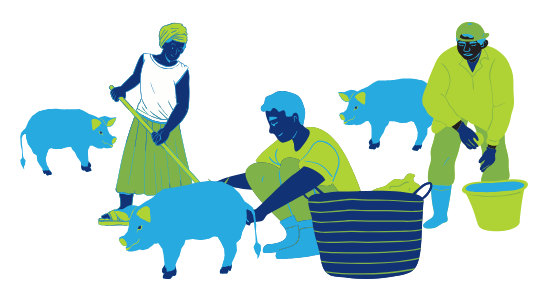
In just one example, Togami says, she assumed farmers whose pigs were affected by a parasitic disease called cysticercosis would sell their animals readily. It was only after listening to them at length that she learned the pigs were actually valuable, long-term investments held against hard times.
Listen as she chats with One World, One Health about what else she’s learning as she works in the classroom and in the field.
Maggie Fox 00:01
Hello, and welcome to One World, One Health, where we take a look at some of the biggest problems facing our world. I’m Maggie Fox. This podcast is brought to you by the One Health Trust, with bite-sized insights into solutions to problems such as infectious diseases, climate change, and pollution. One Health recognizes that everything on this planet- the animals, plants, people, and the climate and environment are all linked.
We’re getting lots of examples right now of One Health problems, with a growing epidemic of Ebola in central Africa, the recent outbreak of an unusual strain of hantavirus among cruise ship passengers, and weather changes that are helping the spread of insect-borne diseases almost everywhere, and these issues are coming just as people are losing their trust in public health. It’s a problem experts have recognized and have worked to fight, yet it seems to only get worse.
In this episode, we’re chatting with someone working to help lead the next generation of One Health troops into the field. Dr. Eri Togami is an epidemiologist and veterinarian who’s already worked with the World Health Organization. Eri’s worked on surveillance and response to both Ebola and COVID-19. Now she’s studying for a PhD in environmental health at the One Health Laboratory at Johns Hopkins University.
Eri, thank you for joining us.
Eri Togami 01:32
My pleasure. Thanks for having me.
Maggie Fox 01:35
Public health experts know they can and should do better, not just in overall preparation, but also in building trust, but they’re failing miserably. Nonetheless, we are all living through some of the biggest global failures, such as a pandemic. You represent the next generation, and maybe our next new hope. What are you bringing us?
Eri Togami 02:00
So, one thing I’m studying right now at Johns Hopkins is how to integrate what we learn from the past, but some of the social science approaches that we know work, like participatory approaches and implementation research, which really focuses outbreak response on the people who are directly affected by it. A contrast to this might be something in the past where a wealthy country goes in and tries to save people who are affected by a disease. Now the whole science community in general and public health is walking towards more co-development participation, not just being told what to do. The people who are affected in the community have the right to know, and we co-create solutions together, so that’s the concept of a participatory approach.
Maggie Fox 02:51
Okay, can you tell us a little bit more about this? Because, as you say, the public health approach has been kind of, “We’re the experts, and we’re here to tell you how to do things,”and obviously that doesn’t work. It doesn’t work in developing countries. It also doesn’t work in wealthier countries. So, can you give us some examples of how to not do that?
Eri Togami 03:09
The participatory approaches that we used were developing a guidebook for zoonotic disease spillover prevention in southeast Asia. So, think about where COVID-19 might have started, or other diseases, maybe in wet markets; it could be in forests where people interact with wildlife. So the task was for a group of scientists and local leaders to try and develop a guidebook in southeast Asia, and this was in 2022 to 2024. So, what we really tried to do was to break the power dynamics in a room, even in a meeting setting.
“Okay, so Who’s there?” You can have professors with a long tenure, you can have somebody like me who was a student at the time, you can have women, people of color, people who are shy, people who are not confident in speaking English, so we put all these people together in a room who can speak and articulate the best. It’s usually people who have more authority and experience.
So, one of the participatory activities we had was to have sticky notes, have everybody be silent, just think about it, reflect on it, and put sticky notes on the wall. We had things like role playing, so there were specific roles assigned, and people could more freely express what they were thinking, really tailoring the examples to what people could see. So, for example, wet markets in southeast Asia. There are specific wildlife species that they’re really asking people who know the ins and outs of those markets to participate. So, even in that meeting setting, when we were developing this guidebook, we were taking a participatory approach, hoping that it wouldn’t be just another official document that you find online from organizations such as the WHO or other governmental organizations,
Maggie Fox 05:09
Is there an example? Then were you able to take that kind of meeting setting and use it in the field? Is there an example of kind of being out among people and not doing a top-down approach that worked?
Eri Togami 05:21
I have the most experience working in Rwanda. I’m working on a different zoonotic disease; it’s called cysticercosis, and it’s a truly One Health issue. So, that means people get sick from this parasite; it can go to the brain and cause epilepsy. In pigs, it can also go to the brain; it could go to the muscles, and it can exhibit neurologic symptoms. It’s also an environmental problem because if people don’t have good toilets and their feces are in the forest or in grasslands, and it rains, then the parasite eggs from the human feces go into the environment, and then it goes into pigs and other parts, so it’s all very closely connected. And in this project, I had the pleasure of speaking with and interviewing some of the local champions, so there are people who work in the villages, community health workers, animal health workers, and hygiene officers, farmers, and butchers, people at the market to really understand, first of all, what they understand, if at all, of this disease that’s affecting people, like there was a very young child who was affected and was severely debilitated because of this disease, or people might lose value of their pigs at the market by up to 80 percent because of this disease. So, we’re really working with the community members to see what they understand, see what gap is there, and see what kind of intervention is accepted in this community.
Maggie Fox 07:02
Okay, you use a word like intervention, but in plain language. What are some of the solutions? How do you cure the pigs of the parasites?
Eri Togami 07:09
Yeah, so it’s a three-pronged approach. So, for pigs, think about an injection in the ear, the vaccine that helps with preventing the disease, and then there’s also a liquid syringe with white milky medicine in it, and we put it in their mouth; that’s the treatment for the pigs, and that helps clear any existing parasites in the body. For humans, it’s like a vitamin pill; that’s an anti-parasitic drug that helps clear the parasite from the human body.
Okay, what about the environment? So, some latrines there are just holes, and sometimes they have curtains or things that cover the site from other people, but sometimes it’s completely open, and that’s bad, because pigs can come in if they’re free-roaming and eat or forage around that latrine and get the feces in the mouth, and that’s the transmission cycle that closes it.
So another intervention we say, but another fix for this disease, is to build better latrines; for example, what if we had a better hole that doesn’t overflow when it rains a lot? What if we had a door that stops free-roaming pigs from going inside? Then it’s all contained. If the pigs don’t get access to the eggs, the parasite cannot survive. I, a veterinarian, am focusing on the pig treatment and vaccination.
So, we’re asking, “Okay, what’s important to you? Did you refuse? If so, why? Did you accept? If so, why?” And when I was interviewing approximately 20 people from the community, and some of the pig farmers are very underserved, it’s not a lot of income that they can generate steadily, so livestock in their setting is really stock, like in a place like the United States, you might buy stock to prepare for the future, right? For them, it’s exactly the same.
So, when I was asking them, “Okay, do you plan to sell your pigs? Is it a regular source of income?” they’re like, “Oh no! only when you know something bad happens,” like a child gets sick, or we need school fees, or something unprecedented happens, and you really need money, that’s your pig.
Maggie Fox 09:33
So, it’s a long-term investment for them; they don’t kill a pig lightly, right?
Eri Togami 09:36
Exactly, that’s something I didn’t know. Going into it, I was thinking more as a rolling stock, kind of come get a pig in after six months, you sell. I thought it was like that, but to some families it’s stock; it’s “livestock.”
So, you can think about the devastating effect if suddenly your stock disappears, and what makes a pig disappear? It’s a disease like cysticercosis. So, it’s a very, very important disease for human health, for pig health, and for the contamination of the environment.
One example of how cysticercosis is embedded in the culture in Yamagabe district, where I work. So, I had the opportunity to go to the live animal market on Tuesdays. So, you drive in; there are hundreds of people, there are cattle, there are pigs, there are chickens, and goats, and they’re all in different sections. You walk in, you go to the pig section if you want to buy or slaughter a pig, or if you want to sell one, and then you kind of, you know, talk to each other. “Oh, how much are you selling for? How much do you buy?” And once the seller and the vendor agree, what do they do first? So they probably negotiate on the price, but also they check for the disease. So, one of the scenes I saw a lot in the live market was the pigs lying on their side, and then the vendor and seller opening the mouth of the pig and checking the tongue, so one person is putting their hand on the pig’s tongue, looking for bumps, and what are those bumps? Those are the cysts; those are the parasites to check if it’s there, and you wouldn’t want a diseased pig, because it might die, and you spend all this money, and then it dies, or you don’t get permission from the government veterinarian to slaughter the pig, so it’s a huge loss.
Eri Togami 11:32
Unfortunately, from a scientist’s point of view, this tongue checking has a very low sensitivity, so that means it might not be in the tongue, it might be in the thighs, be in the stomach, might be in the brain, and even if the tongue is clear, it may still be in the body, but it’s a local custom to do something like that, which comes to show how important this disease is in the pork selling and raising and butchering kind of culture.
Maggie Fox 11:32
So, what were you able to offer that was helpful to the people?
Eri Togami 12:07
So, I’m looking at how we can better tailor the pig intervention by understanding what do people like about it, what do people dislike about it, asking people what worked for them, what didn’t work for them, and then feeding that back to the project leaders, and to see if we can change something, so people can accept it more. An intervention that truly works for their setting, I guess.
Maggie Fox 12:32
Is there a way you can offer them that can be more sensitive? A better way to find whether a pig’s infected.
Eri Togami 12:39
The testing of this disease is somewhat challenging. Instead, really, if we focus on the delivery process of the vaccines and the medication that we already have, one of the challenges was around concerns about ear tags. So, it’s a two-dose vaccine. When you vaccinate one pig, you put an ear tag in, just like a piercing in people, and then you go back to the same house, and then make sure the piercings are there, and then you vaccinate it again.
So, people seem to be somewhat concerned about this ear tag, because they’re unfamiliar with it. That’s something we discovered from my interviews, and so one way to dispel rumors is that the ear tag pigs are part of some kind of project, so we don’t want to buy them at the market. Instead of that, the government veterinarian can communicate to people, “Oh, it actually means it’s a healthy pig, because it’s been treated for this disease.”
Maggie Fox 13:38
And when you get out and start working with people and meeting them and talking to them, what are some of the things you might have learned?
Eri Togami 13:44
So, I had the opportunity to go to Yamagabe District twice and ask people about their lives and pig rearing and their water, sanitation, and hygiene, toilet use, things like that. So, I was spending one day interviewing five different people in a Toyota Land Cruiser, or on the grass, or in a local church, and one thing that I really learned one day was how scarce water was there. An example was at the end of the day; it was around 5 o’clock we were all very tired. I had a water bottle eating some snacks after a long day at work, and my colleague goes, “Hey, Eri, do you have some extra water?” And I said, “Oh, yeah!” And I thought she was thirsty, but actually she was looking out for the people, the community health workers who were helping identify research participants, and she hands my two liter bottle to this lady who has been helping us all day, and she chugged the water bottle down so quickly it was empty, and at that moment I thought, “oh my gosh,” all this time I have all these snacks and water in my bag, she was so thirsty all day, and she was helping us, and I was asking about access to water, and there she was, right next to me, and I was so oblivious to that, and it really, it was a short moment that really brought me back to, “okay, what is it that you’re really trying to do here? Do you really understand?” there was an “aha moment,” for sure.
Another similar experience. I really had to go to the bathroom during one of my interviews, because it was a long day. So, we leave the hotel at 7 a.m., and we don’t come back until 7 p.m. We were conducting interviews to pig farmers in a community worker’s living room, so she leads me to the bathroom and takes me to the household bathroom, and it’s a latrine, and it was very nicely maintained with a door, very private, and then I needed to wash my hands, and she goes, “Oh, okay,” and then looks for a plastic jerry can that people have to go to the river, fill it up. I don’t think that household had bikes or cars or anything, so somebody has to bring that water from down the hill, and I felt so bad washing my hands there with soap, but that was the communication that we were trying to promote, so I had no choice. I almost said, “Oh, I have my hand sanitizer; it’s fine.” So I was, and she was helping me wash my hands with trickles of water, and there I was washing with soap and water, and like really, really experiencing how scarce water is. And in that setting, when I go back to the project, and I’m conducting risk communication and messaging, and say, “oh, make sure you wash your hands with water,” like, make sure you know what kind of resources people have access to every day, and it really brought me back to make sure you at least try your best to understand what people need, what people don’t have, people, what people do have, because knowledge doesn’t translate directly to behavior change.
I’m studying a neglected tropical disease, but it’s the same for a respiratory disease in a high-income country. In Baltimore, where I’m based, you want to look at the social environment, their financial situations, what they know already, what kind of communication that has that they’ve been exposed to, what kind of feelings they might have for the government, for example, what past public health programs may have failed them. All of these things are experiences that people have that shape how they feel about a disease or somebody coming into their neighborhoods. So, it’s very applicable to H5N1, hantavirus, Ebola, although Ebola is in a conflict setting, so that adds another layer of complications, but even in that safe and dignified burials, looking at the local customs, what kinds of conflicts have people been experiencing their whole lives? You really have to look into people’s lives.
Maggie Fox 18:10
Eri, there’s a saying in public health that if you actually prevent something from happening, nobody knows about it, because you prevented it. I’m thinking SARS in 2003-2004 could it have become a pandemic? It didn’t. It could be dumb luck. Would you prevent something from happening? But have you ever seen a public health intervention that did work?
Eri Togami 18:30
I think it’s a bit of both. So the characteristic of the virus is not within human control, so that’s the luck part, and then the part that is not luck is how much investment, how much trust you have between the community and between people who are called authorities.
An expert is nothing if nobody’s listening to you, or if they don’t want to listen to you, because you sound like an expert and you’re just unrelatable. For example, there are so many different experts that work together that there needs to be pre-established trust there too.
So, it’s all about, do you have people you like and who are very capable in the places you need to be? Can you trust them if there’s a problem? Do you have that? If you do, you’re in better shape.
Maggie Fox 19:20
And do you feel like we’re anywhere near that place right now in the world?
Eri Togami 19:26
It’s hard to generalize, but I can say that the challenges in investment right now all over the world are certainly no help, because some people are able to do what they’re really good at in their jobs. Something that we can be hopeful for is that we learnt a lot from COVID-19, and we learnt a lot from mpox and H5N1. We know that if public health officials or people working in one health don’t do the messaging right, somebody else will do it for you. Even if it’s not correct, or even if it’s fear-inducing, or just convenient, so there’s a lot of growth happening amongst the public health community.
Maggie Fox 20:12
Eri, thank you so much for joining us.
Eri Togami 20:14
Thank you very much.
Maggie Fox 20:17
Listeners. If you enjoyed this podcast, please share it. You can learn more about this podcast and other important topics at onehealthtrust.org, and let us know what else you’d like to hear about at [email protected]. Thanks for joining us.
Guest

Dr. Eri Togami is an epidemiologist, veterinarian, and PhD candidate at Johns Hopkins Bloomberg School of Public Health. She uses statistics, interviews, and implementation research to study how people perceive the risk of zoonotic diseases and how medical interventions can be better accepted by community members in Rwanda. Her research is nested in a randomized controlled trial that aims to prevent and control cysticercosis in people and pigs.
Prior to joining Johns Hopkins, she conducted surveillance and outbreak response for infectious diseases, including COVID-19 and Ebola, at the World Health Organization (WHO) Headquarters in Geneva, WHO Western Pacific Regional Office in the Philippines, and WHO Fiji Office. She also worked on a USAID-funded, early-warning virus surveillance project, named PREDICT, at the University of California, Davis.
She obtained her degree in veterinary medicine from Nippon Veterinary and Life Science University in Japan, Master of Public Health from Yale School of Public Health, and a One Health fellowship at UC Davis School of Veterinary Medicine. She is a member of the One Health Action Collaborative at the U.S. National Academies of Sciences, Engineering, and Medicine.
Credits
Hosted and written by Maggie Fox
Special guest: Eri Togami
Produced and edited by Samantha Serrano
Music composed and sound edited by Raquel Krügel
Transcript edited by Namitha Prabhu