May 04, 2026
What is the burden of antimicrobial resistance in India? How can vaccines be leveraged to help control this growing health crisis in the country?
Read the 2026 GARP-India Policy Brief, “The Value of Vaccines to Mitigate Antimicrobial Resistance in India,” to learn more.
Executive Summary
Antimicrobial resistance (AMR) is a major global health crisis, making infections harder to treat and increasing the health and economic burden worldwide. In India, AMR is driven primarily by a high infectious disease burden and antibiotic misuse, causing an estimated 267,000 deaths and factoring in nearly 987,000 others. India’s National Action Plan on AMR (NAP-AMR 2.0, 2025–2029) emphasizes prevention of infections as a key strategy, and vaccination is a powerful, cost-effective tool to reduce infections and antibiotic use.
The Global Antibiotic Resistance Partnership (GARP) in India convened national experts in public health, immunization, and AMR to guide the development of this policy brief. It provides expert insights and recommendations on prioritizing vaccines based on their ability to reduce disease burden and their potential impact on AMR in India.
High Priority Vaccines
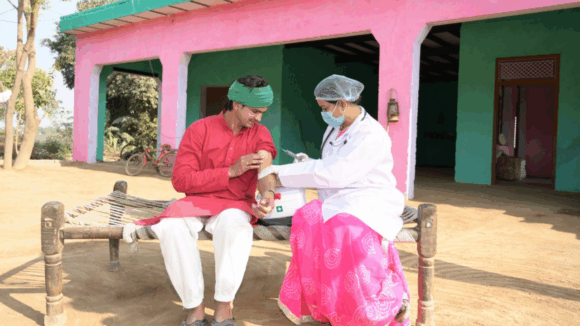
- Typhoid conjugate vaccine (TCV): The vaccine is highly effective (~80–95 percent), with strong evidence for reducing antibiotic use for undifferentiated febrile illnesses and drug-resistant infections. It is recommended for routine childhood immunization, with catch-up campaigns for up to 15 years of age and expansion to adults in high-risk settings.
- Pneumococcal conjugate vaccines (PCVs): India introduced PCV in childhood immunization in 2017. Expanding coverage and introducing adult vaccination (>65 years and high-risk groups) could significantly reduce antibiotic consumption for respiratory infections and prevent deaths. Domestically manufactured and affordable high valancy PCVs tailored to India’s infectious disease burden are needed for scale-up.
Medium Priority Vaccine
- Influenza vaccine: Seasonal influenza drives high antibiotic prescribing for respiratory illness. Annual vaccination, targeting children, older adults, healthcare workers, and high-risk populations, can reduce antibiotic use by 20–30 percent and prevent secondary bacterial infections.
Low Priority but Supportive Interventions
- Respiratory Syncytial Virus (RSV) and other adult catch-up vaccines: RSV immunization and adult booster vaccines (tetanus, diphtheria, and pertussis; measles, mumps, and rubella; zoster; and human papillomavirus) can indirectly reduce inappropriate antibiotic use by preventing viral infections often treated empirically with antibiotics.
Prioritizing typhoid and pneumococcal vaccines, with influenza vaccination as a complementary strategy, can substantially reduce infection burden, antibiotic consumption, and AMR in India. A prioritized vaccination framework for vulnerable groups aligned with surveillance and domestic vaccine production is essential for controlling AMR emergence and spread.
This publication was prepared by GARP-India.
A Christian Medical College and Hospital (CMCH) and One Health Trust (OHT) Initiative
GARP-India Technical Working Group Members & Institutional Affiliations:
Chairperson:
Dr. Priscilla Rupali, MD DTMH FRCP FIDSA, Sr. Professor and Head, Dept. of Infectious Disease, CMCH
Coordinators:
Dr. Prasanna Kumar, Associate Professor, Dept. of Infectious Diseases, CMCH; Dr. Uradi Saraswathi, Clinical Pharmacist, Dept. of Infectious Diseases, CMCH
Members:
Dr. Rajib Dasguptha, Professor & Chairperson, CSMCH, School of Social Sciences; Dr. Satender Aneja, Former Professor and Head of Paediatrics, Lady Hardinge Medical College, Member of the National Technical Advisory Group on Immunization; Dr. Anita Kotwani, Former Director-Professor and Head, Department of Pharmacology, Vallabhbhai Patel Chest Institute, University of Delhi; Dr. Camilla Rodrigues, Consultant Microbiologist, P.D. Hinduja; Dr. Jacob John, Professor in Community Medicine, Department of Community Health, CMCH; Dr. Sumit Rai, Professor and Head, Department of Microbiology, All India Institute of Medical Sciences (AIIMS); Dr. Umang Agarwal, Infectious Disease Consultant, P.D. Hinduja; Dr. Muralidhar Varma, Additional Professor, Kasturba Medical College; Dr. Aravind Kumar, Additional Professor, Department of Medicine, AIIMS; Dr. Sagar Khadanga, Associate Professor, General Medicine, AIIMS; Dr. Aravind Regukumar, Assistant professor of Infectious Diseases at Government Medical college; Dr. Sangeetha Sharma, Professor, Department of Neuropsychopharmacology, Institute of Human Behaviour & Allied Sciences; Dr. Winsley Rose, Professor, Department of Paediatrics, CMCH; Dr. Santosh Taur, Director, Medical Affairs, Vaccines, Rare Diseases & Digital, Pfizer Limited, India; Dr. Anuj Sharma, Technical and Team Focal Point for Antimicrobial Resistance and Infection Prevention and Control,World Health Organization (WHO) Country Office for India; Dr. Anurag Bhargava, Professor in Medicine, and the Head of the Centre for Nutrition Studies, Yenepoya.
One Health Trust:
Dr. Erta Kalanxhi, Mr. Rishi Bhagawati, Ms. Simran More, Dr. Samantha Serrano, Mr. Shreyas Satish Kumar
Download the full policy brief here.