November 28, 2025
What is the burden of antimicrobial resistance in Pakistan? How can vaccines be leveraged to help control this growing health crisis in the country?
Read the GARP-Pakistan Policy Brief, “The Value of Vaccines to Mitigate Antimicrobial Resistance in Pakistan,” to learn more.
Executive Summary
Antimicrobial resistance (AMR) is a serious global health concern that is making infections hard to treat and increasing the health and economic burden worldwide. The AMR burden in Pakistan is challenging the treatment of simple infections, leading to treatment failures. For serious conditions, such as sepsis, pneumonia, typhoid fever, and tuberculosis (TB), AMR is significantly increasing mortality rates. Furthermore, disparities in access to health care, education, and basic resources across the country have led to AMR disproportionately impacting vulnerable communities.
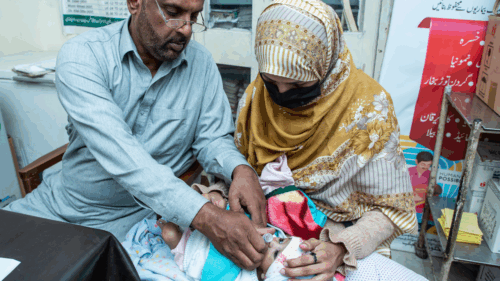
Vaccines are an effective tool to combat the growing issue of AMR while reducing the use of expensive antibiotics. Modeling estimates show that vaccines can significantly avert cases and deaths related to several diseases of public health significance in Pakistan. The Expanded Program on Immunization (EPI) was launched in 1978 to prevent childhood infections and lower the mortality rates associated with them. The current EPI covers TB, polio, diphtheria, tetanus, and pertussis, hepatitis B, Haemophilus influenzae Type B (Hib), pneumococcus, rotavirus, measles, and typhoid. Effective immunization strategies have lowered the burden of morbidity and mortality in Pakistan; however, morbidity from vaccine-preventable infections, such as varicella, mumps, and hepatitis A, is still on the rise. Including vaccines for these diseases in the EPI is expected to further decrease childhood mortality rates. Although childhood immunization programs have shown moderate success in lowering the burden of infection and the use of antimicrobials in children, adults, particularly elderly people, remain vulnerable.
Elderly people, especially those with comorbid conditions, such as diabetes and cardiovascular diseases, are at a higher risk of infections by certain bacteria, such as Mycobacterium tuberculosis and Streptococcus pneumoniae. Given their susceptibility and weaker immune systems, they can carry these infections and transmit them within the community. To circumvent the epidemic of AMR, adult immunization programs should be included in the immunization policy. Promoting vaccination in adults against influenza, pneumococcal infections, and respiratory syncytial virus, and making the conjugate typhoid vaccine available commercially for adults will significantly impact AMR rates by decreasing the burden of bacterial and viral infections and lowering the demand for antibiotics.
Vaccines in the developmental pipeline can also help slow the emergence of AMR. For example, modeling studies have projected rigorous and novel postexposure TB vaccine programs to be effective in significantly decreasing the burden of drug-resistant infection and death rates, especially if coupled with stronger diagnosis and treatment efforts. Effective implementation of such programs could save tens of thousands of lives in Pakistan alone over the next few decades.
To harness the full benefits of vaccines in Pakistan, it is critical to implement and increase coverage for vaccines, such as those against typhoid, pneumococcal infections, mumps-rubella, and rotavirus, in the EPI to lower the infectious disease burden and AMR. Furthermore, it is imperative to maintain and improve immunization rates and introduce programs for adults and elderly people, particularly those with comorbidities. To make this possible, concerted efforts from all stakeholders are needed to manage and improve the EPI and address the burden of infectious diseases and AMR in Pakistan.
The Global Antibiotic Resistance Partnership-Pakistan prepared this publication.
GARP-Pakistan Technical Working Group Members:
Prof. Ejaz A. Khan, Department of Pediatrics and Infectious Diseases, Chair Infection Control and IRB and Ethics Committee, Shifa International Hospital (Chair); Dr. Altaf Ahmed, Head of Infection Control and Clinical Microbiology, Pakistan Kidney and Liver Institute (Co-Chair); Dr. Shaper Mirza, Associate Professor, Syed Babar Ali School of Science and Engineering, Department of Biology, Lahore University of Management Sciences; Salwa Ahsan, Chief of Pharmacy, Department of Pharmacy, Shifa International Hospital; Dr. Khalid Naeem Khawaja, Consultant Microbiologist, Averroes Laboratories; Dr. M. Athar Abbas, (DVM, PhD), Veterinary Microbiologist, Senior Scientific Officer (NRLPD), Fellow (Fleming Fund AMR Surveillance–AH Pakistan), Focal Person AMR (PARC); Prof. Afia Zafar, Chairperson, Department of Pathology and Laboratory Medicine, The Aga Khan University; Prof. Farah Qamar, Associate Professor, Section of Paediatrics Infectious Diseases, Department of Paediatrics and Child Health; Dr. Samreen Sarfaraz, Consultant Infectious Diseases, Chair Infection Control and Program Director ID fellowship, Indus Hospital; Dr. Summiya Nizamuddin, Consultant, Medical Microbiology, Section Head of Microbiology, Shaukat Khanum Memorial Cancer Hospital and Research Centre; Prof. Faisal Mahmood, Professor & Head, Infectious Diseases, Associate Chief Medical Officer, IPC, Agha Khan University, Karachi; Dr. Nasim Akhtar, Assistant Professor and Head of the Department of Infectious Diseases and In charge HIV AIDS Treatment Center, Pakistan Institute of Medical Sciences, Islamabad; Abdul Mughees Muddassir, Assistant Director to CEO-Drug Regulatory Authority of Pakistan (DRAP), Islamabad; Prof. Saira Afzal, Chairperson and Head of Community Medicine and Epidemiology, Director Foreign Affairs and Internal linkages, Dean, Public Health and Preventive Medicine King Edward Medical University; Sundus Maria, Clinical Pharmacist, Shifa International Hospital (GARP Coordinator)
One Health Trust:
Rishiraj Bhagawati, Simran More, Dr. Erta Kalanxhi
Download the full policy brief:
The Value of Vaccines to Mitigate Antimicrobial Resistance in Pakistan