Bats can carry several viruses that can kill humans. Some well understood – rabies, the deadliest virus of all, is transmitted directly from bats to people from bat bites. Other viruses, such as Hendra virus, are a little more mysterious and indirect in how they spread. And researchers are still unsure how viruses such as Ebola, Marburg, and the coronavirus that caused Covid-19 get from bats to people.
However, a team working in the Queen Elizabeth National Park in Uganda may have just gotten a big clue.
Bosco Atukwatse, a Ugandan wildlife biologist working with the Kyambura Lion Project, set up solar-powered cameras near the mouth of Python Cave in the Maramagambo Forest in the park. He knew the cave was home to multitudes of Egyptian fruit bats and was hoping for pictures of leopards and spotted hyenas.
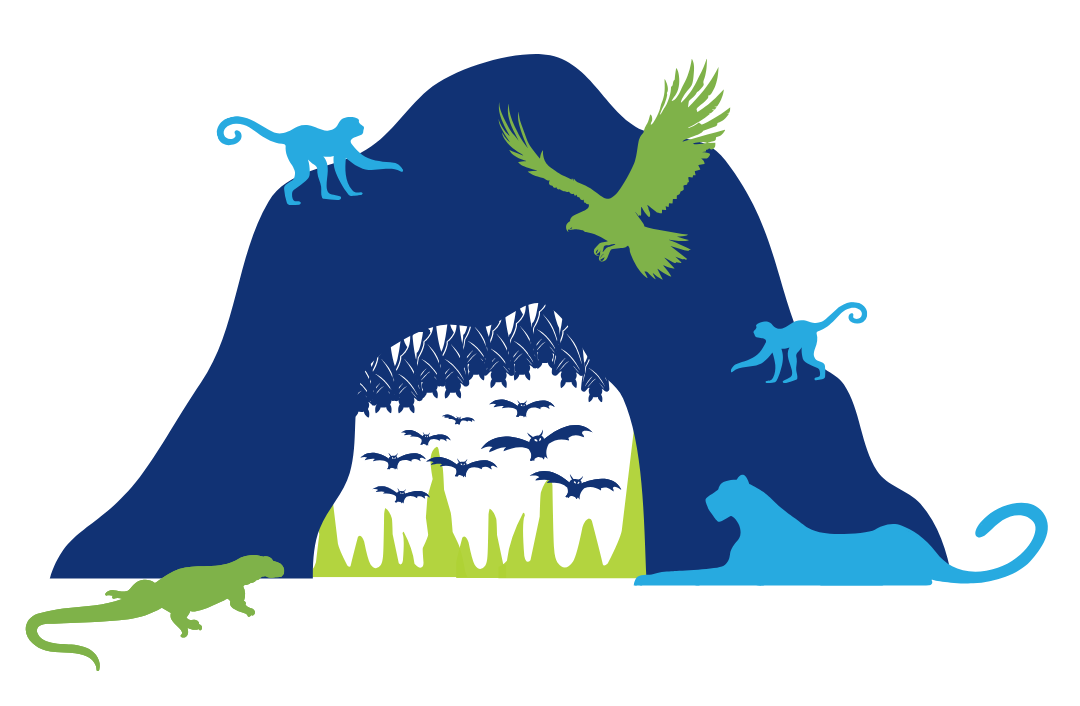
What he got were dozens of images of animals hunting the bats. Birds, snakes, giant lizards called monitors, a very persistent leopard, monkeys, baboons, and a catlike animal called a genet all regularly hunted in the cave.
This behavior was notable on its own. But the bats in this cave are also known to be infected with Marburg virus, a rare but deadly virus that can cause a hemorrhagic fever. Two visitors to the cave had been infected with Marburg, including a Dutch tourist who died in 2008 and a U.S. tourist.
The findings don’t prove that animals who hunt bats are spreading Marburg, says Dr. Alex Braczkowski, Science Director of the Kyambura Lion Project, who reported the discovery on the open repository site Zenodo. They do, however, provide a starting point for possible further investigations.
Listen as Alex and Bosco chat with One World, One Health host Maggie Fox about the bats, the animals that hunt them, and what it all might mean.
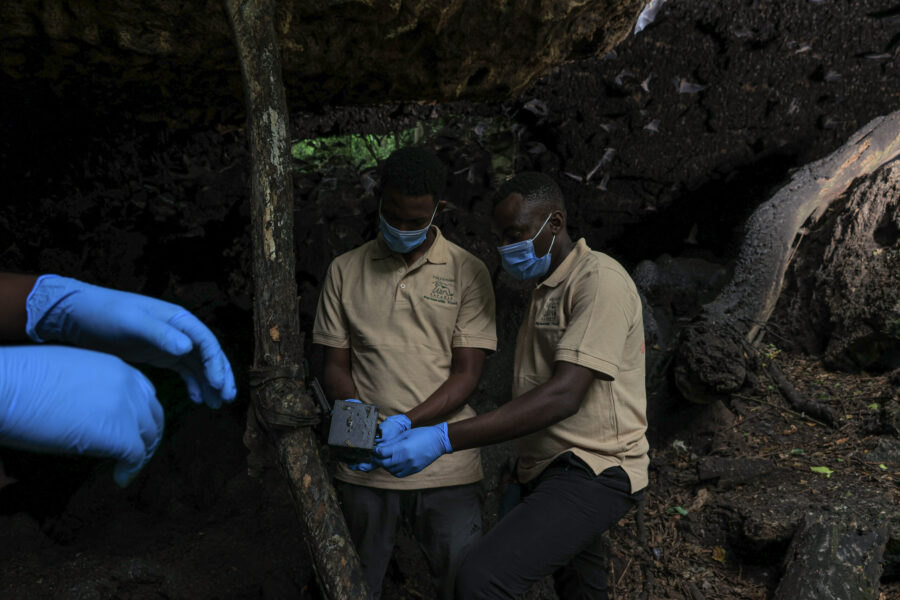
Setting up camera traps at Python Cave
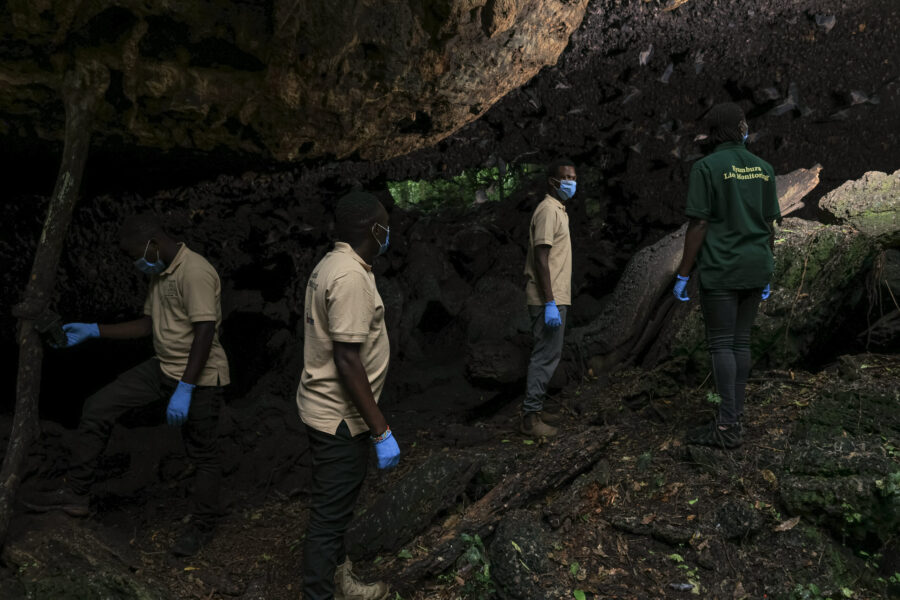
Researchers observing the bats at the mouth of Python Cave
Photos courtesy of Alex Braczkowski
Maggie Fox 00:01
Hello and welcome to One World, One Health, where we chat with people working to solve the biggest problems facing our world. I am Maggie Fox. This podcast is brought to you by the One Health Trust with bite-sized insights into ways to help address challenges, such as infectious diseases, climate change, and pollution. We take a One Health approach that recognizes that we are all in this together, and everything on this planet — the animals, plants, people, and the climate and environment — is all linked.
A very good example of this link comes from bats, which harbor a number of viruses that affect people. Think coronaviruses such as COVID, think rabies, the deadliest virus known. Think Ebola, remember that one? And Marburg, it’s a very close cousin. But people often catch these viruses directly from bats. Sometimes the link is more mysterious. It’s still not clear, for instance, how people catch Ebola or Marburg from bats in parts of Africa.
A team working at the Kyambura Lion Project, part of the Volcanoes Safaris Partnership Trust in Uganda, got some unexpected insight into how this might possibly happen. They were setting up cameras to see what large animals such as lions and leopards were up to. What they found surprised them.
In this episode of One World, One Health, we’re chatting with Bosco Atukwatse, a wildlife biologist, and Dr. Alex Braczkowski, science director of the Kyambura Lion Project, a conservation biologist and wildlife photographer. They discovered at least 14 different species of animals, from leopards to giant lizards called monitors, were using a cave filled with Egyptian fruit bats as a kind of snack bar. This was startling because no one had documented that so many different animals were eating these bats, and it was a bit worrying because these bats are known to carry Marburg virus, a type of virus that can cause a rare but deadly hemorrhagic fever. And this was a difficult podcast to get together. Alex joined us from his base in Brisbane, Australia, and Bosco joined us from the Queen Elizabeth Conservation Area in Uganda. Bosco, thank you so much for joining us.
Bosco Atukwatse 02:21
Thank you.
Maggie Fox 02:23
So, what you found was that a bunch of animals were visiting this cave and hunting the fruit bats. Can you describe what your camera showed?
Bosco Atukwatse 02:26
Part of our surveys that we run in this park is, we conduct annual population surveys of large predators, such as lions, leopards, and hyenas, and we use different methods for lions and for hyenas and leopards combined; we use the same method, which is camera trapping.
So, part of the places where we’re supposed to put these camera traps is where there is a bat cave called the Python Cave. So, it is a dome-shaped cave. As I can say, how these volcanic caves are—like, they have like, multiple openings, or like, one single opening, but this one has only two openings, one in the front and the other in the back. So, it’s a cave. On top, there are a number of trees, big trees, and on the floor, it’s just mounds of guano shared by these bats, and on the sides and down there are some crevices, like holes where pythons and bats all hide down there, most probably where they breed out.
All camera traps have revealed 15 species actively interacting with the bat cave and the bats themselves. We have the actual predators and the scavengers that are feeding on these bats and bat remains.
Predators so far we’ve recorded are the African leopard (Panthera Pardus), and it’s one sub-adult male that frequently visits these caves and picks a bat, or more bats, like in one go, and just eats them, sometimes in front of the cameras, just carries them away from the cave area.
And then there are a couple of birds, raptors, eagles, that just come and pick a number of birds and just fly away with them. There, you can’t trace where they take them, but sure enough, there are those that actually eat them right in front of the cameras and have all those videos.
So it’s an active cave that is 24 hours active, like there are animals that will use it, make use of it during the day, and others will make use of it during the night, depending on the actual activeness of these animals, these species. Those that are actually nocturnal will always visit the cave at night: the owls, the African civets, the genets. We’ve registered the largest spotted genets, whereas during the day, other animals will also come. However, the leopard has come both day and night.
Maggie Fox 04:52
Now, Alex, can you tell us a little bit about how this came about? This is part of a larger project, and it’s a collaboration that you’ve got going. Can you tell us a little bit about what’s going on?
Alex Braczkowski 05:00
There, yeah, Maggie, so the Kyambura Lion Project is part of a longer leopard, lion, and spotted hyena monitoring initiative that we founded in 2023, and it’s based largely on a broader collaboration with the Ugandan Wildlife Authority, which is the Ugandan Government.
The mandate of our project is to provide a scientific monitoring wing, if you will, to the government to try and figure out how many lions, leopards, and hyenas remain in different protected areas around the country.
So, Bosco and the rest of the team essentially drive a lot of the field efforts around that. And as Bosco said, that’s sort of how the discovery came about. He was setting his camera traps as part of a long-term monitoring grid, and, you know, he just happened to feel that maybe I should set a camera at the cave. So that’s how this all sort of came about.
Maggie Fox 05:52
So, weren’t the bats trying to get away from these animals that are hunting them?
Bosco Atukwatse 05:57
So, when I describe the architecture of the cave, the roof is where these bats roost. And there are 400,000 or more bats just roosting in clumps. They’re just basically packed close to each other in such a way that you could barely see the roof itself. So, it’s bat after bat, all of them come together, probably to get some warmth, or, yeah, for a secure feeling.
But for the videos that we’ve got, it’s difficult for all of them to actually fly away. There is always going to be a chance for a leopard to just stand on the mount and just pull like five birds at one time and put them in its mouth and just go away. Birds like the African fish eagle, which we thought actually fish, because of their name, have actually been feeding on these birds for a really long time, and we’ve had the videos since January this year.
So just the way they are densely packed together exposes them to vulnerability to these birds, and so the distance between the cave flow and the roof is just short. It’s about a meter or a meter and a half, so it’s easy for any animal to just stand on the floor and grab a mouthful of bats and run away with it.
Maggie Fox 07:10
And apparently, there are so many bats that the predators go a little nuts. It’s like a snack bar for them or something, and they’re acting in an unusual way.
Bosco Atukwatse 07:20
Well, yeah, the principle behind predation is that predators will always want to invest the least amount of energy in getting food. And this, of course, is self-explanatory; they always want to go to places or to get the prey that is easiest to kill. And for these birds, you can imagine an apple tree, or like a mango tree, the mangoes are just hanging there. You just, you know, raise and pick one. It’s much easier than, you know, chasing a deer or like a little antelope in the forest, you can imagine. So that’s why, probably the leopard has just found a place to pick a snack every time that it can.
Maggie Fox 07:55
And tell me a little bit about some of the other animals you saw, because you expect to see a leopard or something, or even an eagle. But what else did you see in there hunting?
Bosco Atukwatse 08:05
Surely, we have actually seen the central African rock pythons. They’re the largest species of snake in Africa. And seeing these snakes just primarily feeding on bats because they are where they are, I doubt if there’s any chance of them actually getting any other prey. However, it’s not only one snake species. It’s just interesting also to know how many snake species there are, interacting with each other and with the birds, and being able to respect the rule of ecology, where it survives for the fittest.
So, we have male monitors that have also, you know, we’ve also had many videos of them killing bats. And then one other interesting aspect is the monkeys. We’ve got the blue monkeys, actually hunting. They jump down from a tree and pick a bat, or bats, and quarrel with them. So, you can imagine how crazy that is. It’s a couple of videos we have got these monkeys, you know, taking parts away. And for most of these cases, they come sometimes as individuals or in a troop of them, and then they just come like surprise birds.
Well, it’s not surprising because bats are just looking. They are watching, but because they are so cramped, it’s not easy for them to actually jump away to escape. So, there is always going to be, like, a big chance for a monkey to pick bats so easily.
Maggie Fox 09:26
So interesting, do you normally see monkeys hunting bats?
Bosco Atukwatse 09:31
Not really. I think it’s only one paper on the internet that describes chimps feeding on bat guano in a certain forest in Uganda. But no one has actually seen monkeys feed on bats in Africa.
Maggie Fox 09:46
Wait, chimpanzees eating bat guano. You mean they’re eating the bat feces? The poop?
Bosco Atukwatse 09:31
Exactly. Yes.
Maggie Fox 09:46
Boy, that’s kind of disgusting.
Bosco Atukwatse 09:56
Sounds disgusting, but it is zoonotically important!
Maggie Fox 10:01
It surely is, because, okay, all these diseases that bats carry a lot of, they’re found in the guano, right?
Bosco Atukwatse 10:08
Yeah, guano, yeah, and fluids and blood and blah, blah, everything like that. So, you can imagine that what we’ve found out at the cave is a door for scientists to investigate if bats are carrying Marburg virus disease; it is possible that other animals that are interacting with the bats (might be carrying them too)?
Maggie Fox 10:27
Can we talk a little bit about Marburg? It’s a close relative of Ebola, and both of these viruses have caused numerous outbreaks and epidemics across Africa.
Alex Braczkowski 10:38
Yes, I think what Bosco and I can both humbly admit, you know, we are not virologists, we are ecologists, so we kind of look at this from an ecological lens. So, as you said, you know, it is a filovirus, and it’s a close cousin of Ebola, and it causes this viral hemorrhagic fever. This particular bat roost actually has Marburg, so they isolated that roughly between five and seven and a half percent of this population of bats in the cave are shedding this virus. So yes, it’s one of the deadliest viruses on Earth, and it’s also found in this cave.
Maggie Fox 11:10
And people have been wondering how either virus could have traveled from bats to people. And you all aren’t saying you have seen that somehow, having all these other animals has amplified it, but you’ve added another piece to the puzzle.
Alex Braczkowski 11:24
So if you look at the foundational work of the Centers for Disease Control and Prevention (CDC), they have hypothesized two pathways: one that people enter the cave and they catch the virus directly from the bats, and two, from their spatial mapping, where they put global positioning system backpacks onto the backs of the bats. The bats fly into human gardens, and they eat a fig tree. The fig tree drops to the ground. A child may eat a fig that has bat excrement or saliva on it. There’s your spillover pathway.
However, Bosco has potentially uncovered a web of other pathways. It could be a Nile monitor, it could be a leopard, it could be the blue monkeys. So, I think that’s the beauty of Bosco’s discovery, that he’s shown this other potential spillover, sort of pathway.
Bosco Atukwatse 12:08
I mean, in the beginning, we weren’t that much concerned, only that when we saw the leopard feeding on the birds. Oh, Jesus. Like, what is this? Has a leopard ever fed on a bird before? And that’s how you, you know, you start reading literature. Has it ever happened? Yes, there are a couple of photos of leopards feeding on African Fox bats somewhere in India. And yeah, so there you are, you know, you realize that there is not so much information about what you’ve just seen, and that gives you, actually, an advantage of publishing your own findings.
But, you know, monkeys feeding on birds, there could be literature showing monkeys feeding on guano or people, you know, theoretically hypothesizing that. But where is the evidence? This is the evidence that we’ve got. So, it’s important to actually note it out in the science world that — “hey, actually this is happening!” And maybe, if we have been monitoring wildlife in a certain way, maybe, we can adjust and use modified and better technology like camera traps, which are, of course, non-invasive. They’re not gonna disturb anything happening. It’s much better than visiting the place frequently to take any kind of data.
It wasn’t out of training or advice for me to go out and look for the bats or the cave or anything. It’s just this kind of ecological sensitivity, like you just get too sensitive in the ecosystems where you are working. So I’ve been in the forest. I’ve been in the bush, or let me say bush specifically, I’ve worked in the park for the last six years now. So, it was like something that triggers your mind to be like, “Okay, what actually happens here?”
So, to me, it’s very exciting that the information that we’re giving out is going to be of help at some point in time. Because usually scientists and virologists have believed that there are maybe only one or two ways in which viruses leap from species. They always thought bats carry viruses to people’s places and blah blah, and drop the poop and, you know, but there is actually a complex cycle through which they could, you know, be transmitted. You can imagine how many of those animal species that I’ve mentioned interact normally with the others in the Savannas and then with the communities. And, considering the location of the bat cave is not very far from the community, there is a high chance that many people might contract disease at any chance, also, the tourists that visit the cave, also with minimal or no personal protective equipment, might be assistive risk. So, it’s important for us to air it out to the world. It will be like, “Okay, maybe there is a better way that we could protect ourselves from these viruses.”
Maggie Fox 14:47
Bosco, Alex, thank you so much for taking the time to chat with us.
Alex Braczkowski 14:50
Yeah, thanks again.
Bosco Atukwatse 14:53
Thank you, too. Also, thank you guys for, you know, recognizing this. I’m sure many people wouldn’t take it as any point, and especially if it is from a young man, an African from a poor country, Uganda. Yeah, there’s something we’ve discussed with my people around that they were like, “Oh, maybe some people will not take it seriously because just from a nobody,” people, until you’ve, like, a PhD and blah, blah, then people will think of your work as important. But thank you guys for seeing this as quite important.
Maggie Fox 15:24
Listeners. If you enjoyed this podcast, please share it, and please have a look at the website at onehealthtrust.org. We’ll share some of the pictures that Alex and Bosco took. And if you have ideas for subjects you’d like us to cover, let us know at [email protected]. Thanks for joining us.
Guest

Bosco Atukwatse is a wildlife biologist with Kyambura Lion Project at Queen Elizabeth National Park in Uganda.

Dr Alex Braczkowski is a South African conservation biologist working on large mammal and human wildlife conflict issues in east Africa. He is the science director of the Kyambura Lion Project in western Uganda where he helps shape efforts to monitor carnivores across the country.
Credits
Hosted and written by Maggie Fox
Special guests: Bosco Atukwatse & Dr. Alex Braczkowski
Produced and edited by Samantha Serrano
Music composed and sound edited by Raquel Krügel
Transcript edited by Namitha Prabhu